

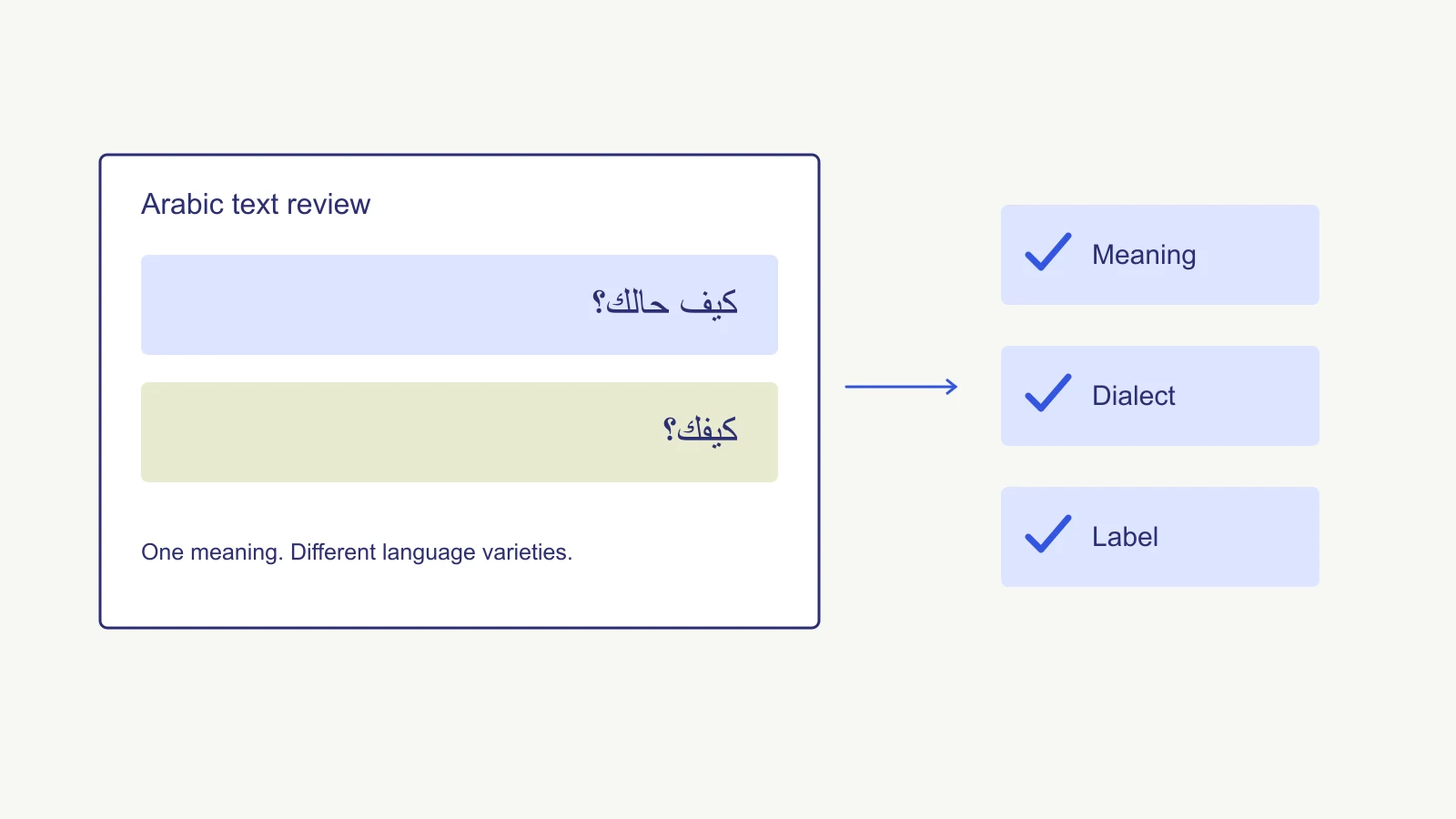
Arabic data annotation needs more than a language label on a project brief. Specify which language varieties appear in the material, what reviewers must decide and how difficult cases should be handled. Otherwise, a project can produce consistent-looking labels that reflect different interpretations of the task.
The recommendations below are a planning framework for text annotation. Speech transcription and specialised legal or medical review require additional task-specific guidance and expertise.
Define the language coverage
Identify whether the material contains Modern Standard Arabic, particular dialects, mixed Arabic and English, or Arabic written in Latin characters. Do not assume one reviewer profile covers every case equally well.
Describe the source context too. A formal report, a support conversation and an informal message can require different handling even when all three are described as Arabic. Where dialect coverage is uncertain, sample the material before assigning reviewer requirements.
Keep “unknown” and “mixed” as possible outcomes when the task calls for language classification. Forcing a narrow label can hide genuine uncertainty.
Separate reading the text from changing it
Decide whether reviewers should preserve the original text, correct it or produce a normalised version. These are different deliverables. Silent correction makes it difficult to reconstruct what the reviewer saw.
For an entity-labelling task, preserving the source text may be essential to maintaining character offsets. For another task, a separately stored normalised version may be useful. The brief should specify which fields can change and which must remain intact.
The CODA research paper describes conventions for dialectal Arabic spelling, with an Egyptian Arabic application. It is a useful reference when considering normalisation, not a universal requirement for every annotation task.
Document the treatment of punctuation, spacing, diacritics, spelling variants and embedded English. Use examples from an authorised sample rather than inventing rules in isolation from the data.
Write guidelines for ambiguous cases
A label list is not a complete annotation guide. Include a definition, a positive example, a counterexample and an escalation rule for each important decision.
For a hypothetical support-intent task, a message might both request a cancellation and complain about an earlier delay. The guide needs to say whether multiple labels are allowed, which intent takes priority and when a reviewer should flag the item. This is a task-design choice, not an inherent property of Arabic.
The same applies to sarcasm, implied meaning and missing context. Reviewers should know when to record uncertainty instead of filling gaps with assumptions.
Build a quality review plan
Use a pilot containing a mix of ordinary and difficult cases. Ask reviewers to work independently on a shared subset, then discuss the reasons for disagreement. The aim is to distinguish unclear instructions from reviewer mistakes and cases that remain genuinely ambiguous.
| Check | What it can reveal |
|---|---|
| Required-field validation | Missing labels or incomplete outputs. |
| Label-frequency review | Unexpected concentrations worth investigating. |
| Shared-item review | Differences in how reviewers interpret the task. |
| Dialect-specific review | Coverage gaps hidden by an overall result. |
| Adjudication notes | Decisions that should be added to the guide. |
No single agreement score establishes that the labels are correct. Review a sample of decisions and inspect important categories separately. Record changes to the guidelines so later batches can be interpreted fairly.
Confirm delivery details before scaling
Agree the file format, encoding, identifier scheme and representation of uncertain items. Test a small delivered file in the receiving team’s workflow before increasing volume. This catches integration problems that a visual spreadsheet review may miss.
For a general model of documenting a dataset’s composition and limitations, see Datasheets for Datasets. For a task focused on ranked model outputs, see RLHF data and human-feedback requirements.
SOAR’s AI annotation and RLHF service scopes language coverage and reviewer requirements for each project rather than assuming every dialect and subject is available.