

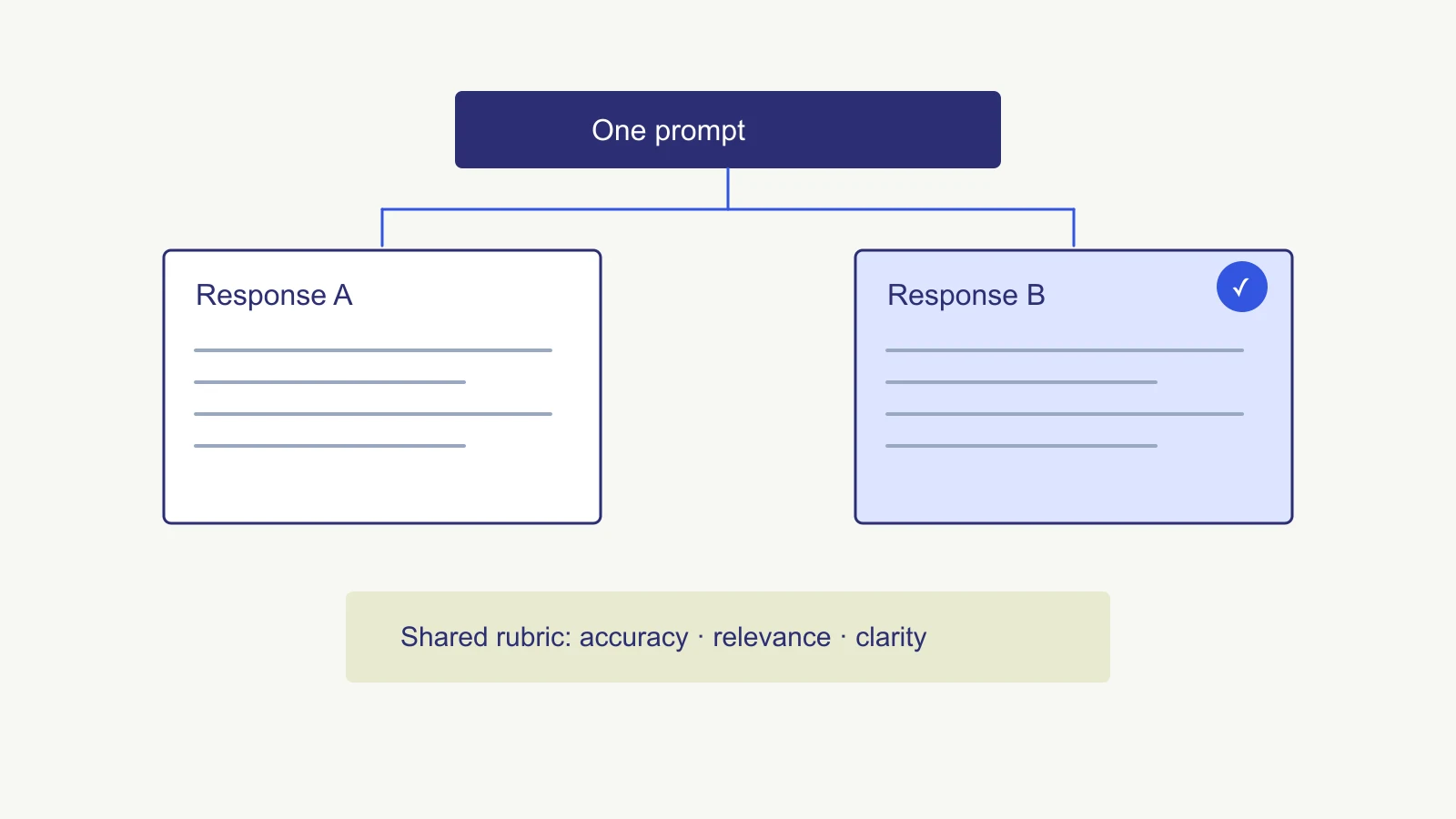
RLHF stands for reinforcement learning from human feedback. The human-feedback work can include reviewing and comparing model responses, but collecting those judgements is not the same as running the full training process. A project brief should say exactly which part a supplier is expected to deliver.
For buyers of annotation services, the practical question is often simpler: what will reviewers see, what will they return and how will the receiving team use the results?
Distinguish the tasks
The InstructGPT research paper describes a training approach using demonstrations and rankings of model outputs, followed by model-training steps. It is a useful example of how human-created data can fit into a larger pipeline. It is not a requirement that every project follow the same design.
| Task | Reviewer output | Main question |
|---|---|---|
| Demonstration writing | An example response | What should a suitable answer look like? |
| Preference ranking | A comparison or ordering | Which response better meets the criteria? |
| Rubric-based evaluation | Scores, labels or explanations | How does an output perform on defined dimensions? |
| Error annotation | Error categories or marked spans | What specifically went wrong? |
The same interface can support different purposes. A pairwise comparison might be used to build training data or to assess a model. State the purpose in the brief rather than assuming the task format explains it.
Give reviewers enough context
A reviewer may need the user’s instruction, relevant conversation history, reference material and any constraints on the answer. Without those, a response can seem reasonable while failing the actual task.
For example, a hypothetical answer might be factually correct but use a format the user explicitly rejected. Another might sound confident but rely on information absent from the supplied references. The rubric should explain how to treat those cases.
Keep presentation consistent where possible. Differences in formatting or unnecessary identifying labels can distract from the judgement the task is intended to capture.
Define the ranking rules
Explain the dimensions reviewers should consider and how conflicts between them are resolved. Accuracy, relevance, completeness, language quality and instruction-following need not receive equal weight for every task.
Specify whether ties, “both unacceptable” and “insufficient context” are valid outcomes. If a system requires a single choice, explain how edge cases are handled and recorded. Otherwise, a forced choice can look like a confident preference in the final dataset.
Ask for a rationale when it serves a review or analysis purpose. A long explanation on every item is not automatically useful; its value depends on what the receiving team will do with it.
Calibrate before increasing volume
Start with a shared set of items that tests the hardest decisions in the guide. Compare reviewer reasoning, not only the chosen labels. Resolve unclear instructions and record examples that clarify the intended standard.
Keep training and evaluation purposes distinct in the project design. The model team should decide how datasets are separated and protected from inappropriate reuse. The annotation brief should make those boundaries visible to the people preparing the work.
Specify the handover
A useful delivery specification identifies the item, the rubric version, the judgement and any allowed uncertainty or escalation outcome. Define whether reviewer identifiers are needed and how they should be represented. Confirm the format using a small sample file before production.
SOAR provides annotation, preference ranking and model evaluation, with scope confirmed per project. Full model training infrastructure is outside the standard service. For language-specific planning, read Arabic data annotation: dialects, guidelines and QA.