

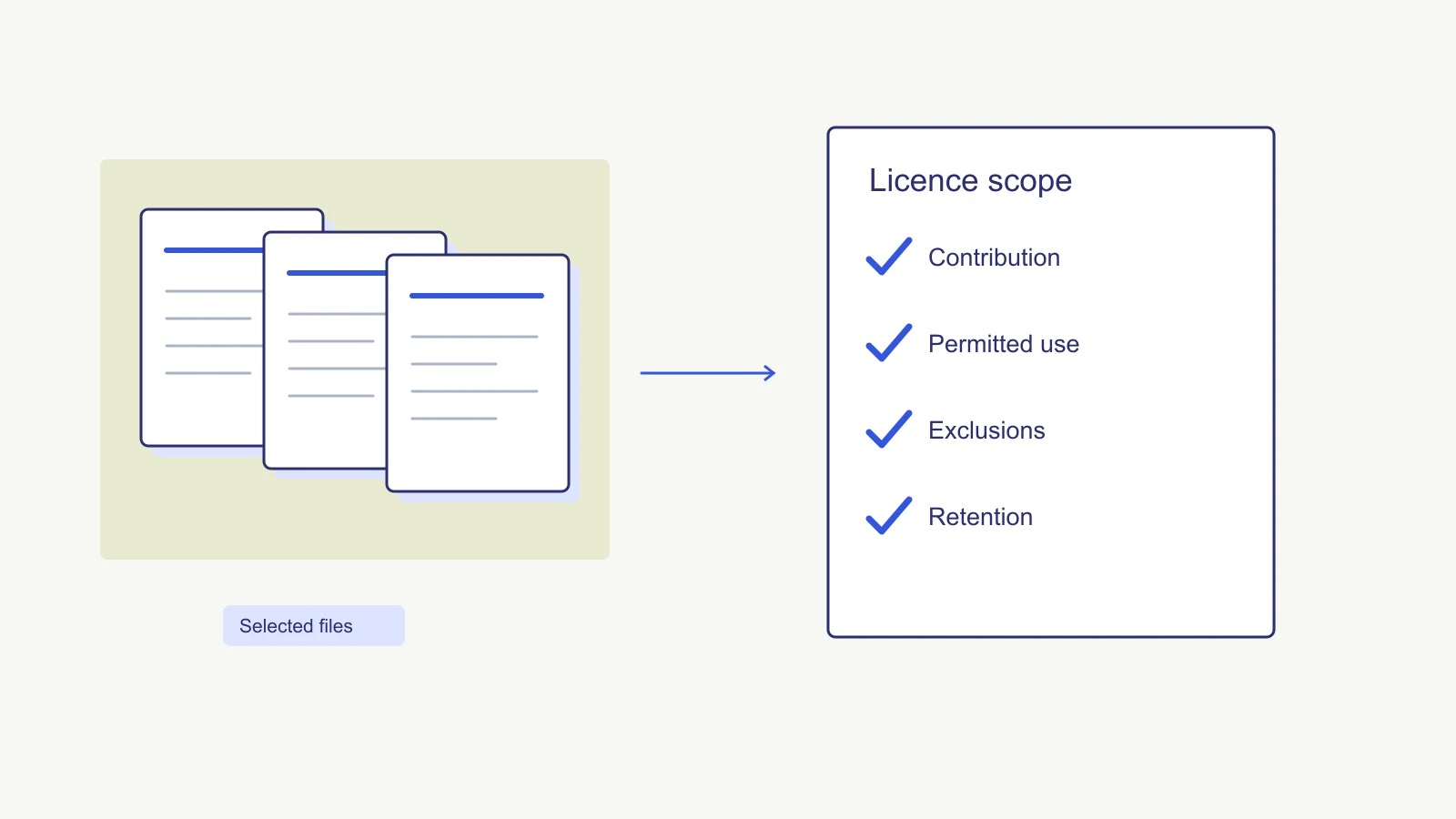
Licensing business data for AI means agreeing how selected material may be used under specified terms. For a company considering a contribution, the first step is to describe the material and the questions it raises. It is not to send an entire workspace export to a potential buyer.
The checklist below helps prepare a commercial discussion. It is not a contract template or a determination that a company has permission to share particular records. Those questions need review for the actual material, agreements and jurisdictions involved.
Make an inventory before sharing files
List the systems and archives that contain relevant work. Describe record types, date ranges, approximate volumes and the business activities represented. Distinguish records you can readily locate from records that may no longer be accessible.
For example, a project archive might contain final deliverables, revision histories, meeting notes and correspondence. Those categories may have different contributors, confidentiality obligations and preparation requirements. Treating the entire archive as one item makes those differences harder to assess.
A useful inventory has five columns: material type, business context, period covered, responsible owner and unresolved questions. Keep it descriptive. It should help someone assess a potential fit without exposing the underlying contents.
Identify a limited first contribution
Choose a proposed boundary that people can understand and review. That might be one completed project, a defined period or a particular record type. A narrow scope makes it easier to describe the contribution and estimate the work needed to prepare it.
Consider what would be lost if parts were removed. A set of disconnected files may not support a workflow task, while a carefully selected sequence may. The aim is not to share more by default, but to understand the relationship between scope and usefulness.
Scale’s public data partnership page describes limited starting scopes and contributing-company approval. Those are features of its stated programme, not evidence that a particular SOAR enquiry will be accepted or paid.
Prepare the commercial questions
Before discussing a price, make sure both sides are describing the same contribution. The following are topics to resolve with the appropriate advisers and counterparties:
| Topic | Discussion question |
|---|---|
| Intended use | What activities would the licence permit? |
| Recipients | Which organisations would receive or use the material? |
| Exclusivity | Would the arrangement limit other uses or licences? |
| Scope | Which records, periods and versions are included? |
| Preparation | Who performs, reviews and pays for preparation? |
| Acceptance | What makes a delivery acceptable, and what happens if it is rejected? |
| Commercial terms | What triggers payment, and is another delivery optional? |
Do not assume a recurring arrangement simply because the source generates new records regularly. Additional contributions need their own agreed scope and commercial treatment.
Resolve responsibilities before a handover
Identify who can answer questions about the records and who can approve a proposed contribution. Ownership of a system account is not a substitute for reviewing the material and the relevant permissions.
The preparation discussion should cover exclusions, transformation requirements, review steps, transfer arrangements and retention expectations. If an issue cannot be resolved, reduce the scope or leave the material out of the proposed contribution.
What to put in a first enquiry
A first message can be brief: the type of organisation, the kind of archive, the period it covers and the person who can discuss it. Do not include credentials, raw records or sensitive information. There is no reliable value estimate without understanding the material and the receiving team’s requirements.
SOAR helps organisations explore data sourcing and licensing opportunities. For the buyer’s perspective, see what makes enterprise data useful for AI training.