

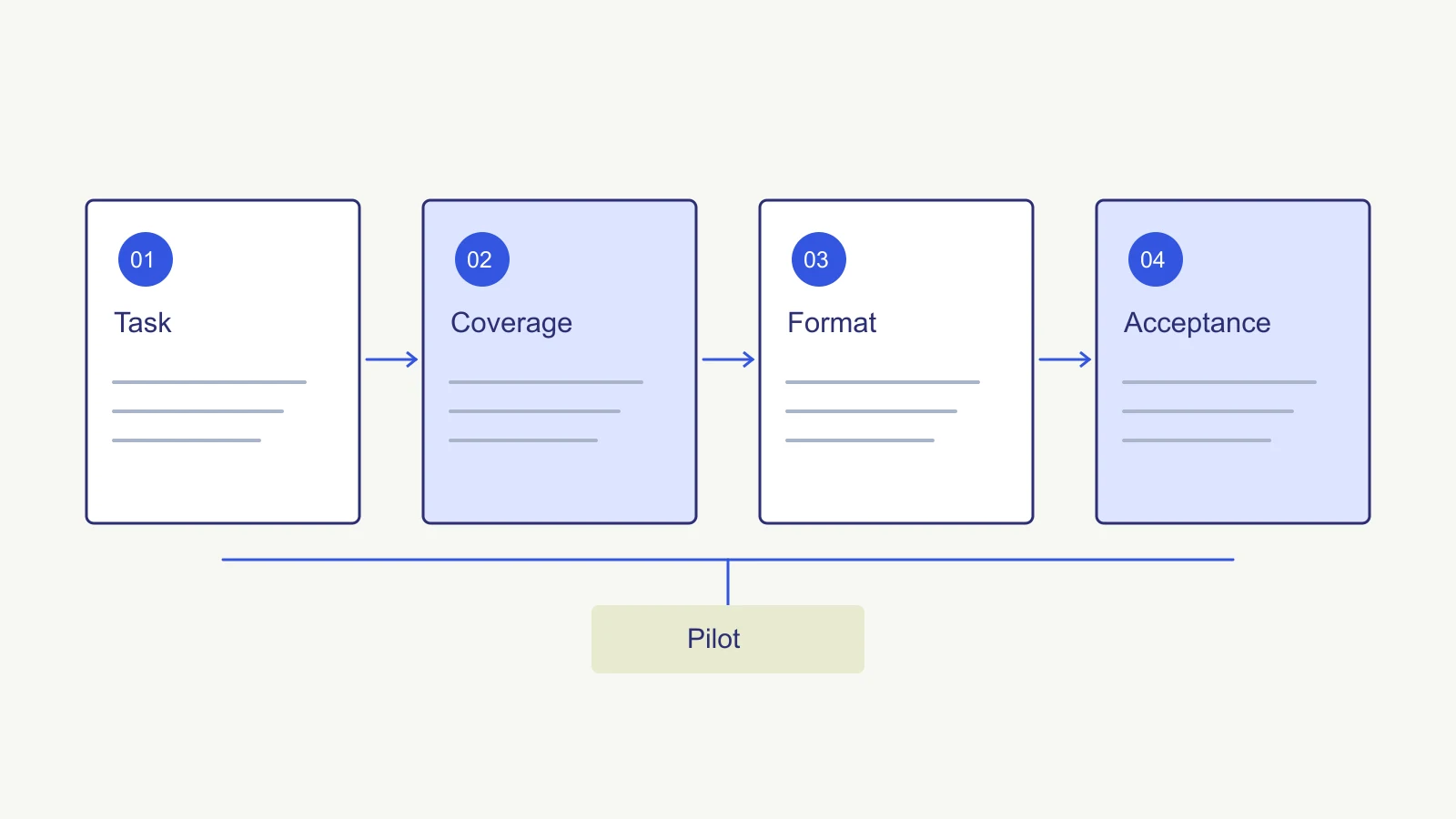
An AI training data brief should explain the task, the material required and the conditions for accepting it. It should let a potential source say whether it can meet the requirement, where uncertainty remains and what a pilot would need to establish.
Below is a reusable structure for a sourcing or annotation discussion. Adapt it to the actual project. Numbers and formats should come from the receiving team’s needs rather than a generic template.
Describe the task in one paragraph
State what the model or system is expected to do. Include a typical input and the expected output. Explain whether the material is for training, evaluation or another use, rather than grouping everything under “AI data.”
A brief such as “Arabic customer-service data” leaves several questions open. Are you looking for conversation examples, labelled intent categories or ranked candidate replies? Does a reviewer need the full conversation, or only one message? Will the task involve a particular product or sector?
Settling these questions early prevents a source from preparing material that fits the language requirement but not the task.
Copy this brief structure
| Field | What to write |
|---|---|
| Objective | The specific task and why the data is needed. |
| Material | Record types, subjects and examples of suitable items. |
| Language | Language varieties, dialects and mixed-language cases. |
| Context | What must accompany an item for it to be understood. |
| Coverage | Dates, populations or situations to include and exclude. |
| Output | Required fields, formats and supporting documentation. |
| Review | Quality checks, reviewers and disagreement handling. |
| Permissions | Intended use and questions the parties must resolve. |
| Pilot | A limited deliverable that tests the main uncertainties. |
| Acceptance | Measurable conditions for accepting or revising the work. |
Mark each requirement as essential, preferred or to be discussed. A long list of supposedly essential conditions can obscure the few requirements that actually decide whether the project works.
Make acceptance criteria observable
“High quality” does not tell anyone how to review an item. Define what can be checked: required fields present, files readable, labels drawn from the agreed taxonomy, relevant context included and exclusions applied.
For subjective work, specify the review process as well as the desired result. An answer can be fluent but unsupported, or correct but irrelevant. A rubric should explain how those differences affect the judgement.
An example acceptance condition might be: every delivered item has a unique identifier, a source category and a completed task label or an explicit reason it could not be labelled. That is an illustrative condition, not a universal standard. Your task may require different fields.
Use a pilot to resolve uncertainty
A pilot is useful when it tests something you do not yet know. It might establish whether the archive contains enough context, whether a file format can be read or whether two reviewers interpret a rubric consistently.
Write down the question the pilot must answer. Choose a sample that includes difficult cases as well as straightforward ones. Agree what happens after review: proceed, change the requirements, run another limited test or stop.
Avoid treating the pilot as a miniature bulk order with no learning objective. Its value is in reducing uncertainty before committing to a larger scope.
Record the version everyone agreed to
Keep the brief, field definitions, examples and review rules together. Date changes and record which version applies to each batch. Otherwise, a later clarification can be mistaken for a requirement that was present from the start.
For documentation principles, Datasheets for Datasets is useful background. For the next practical step, discuss your brief through AI data sourcing or read our guide to human-feedback tasks.