

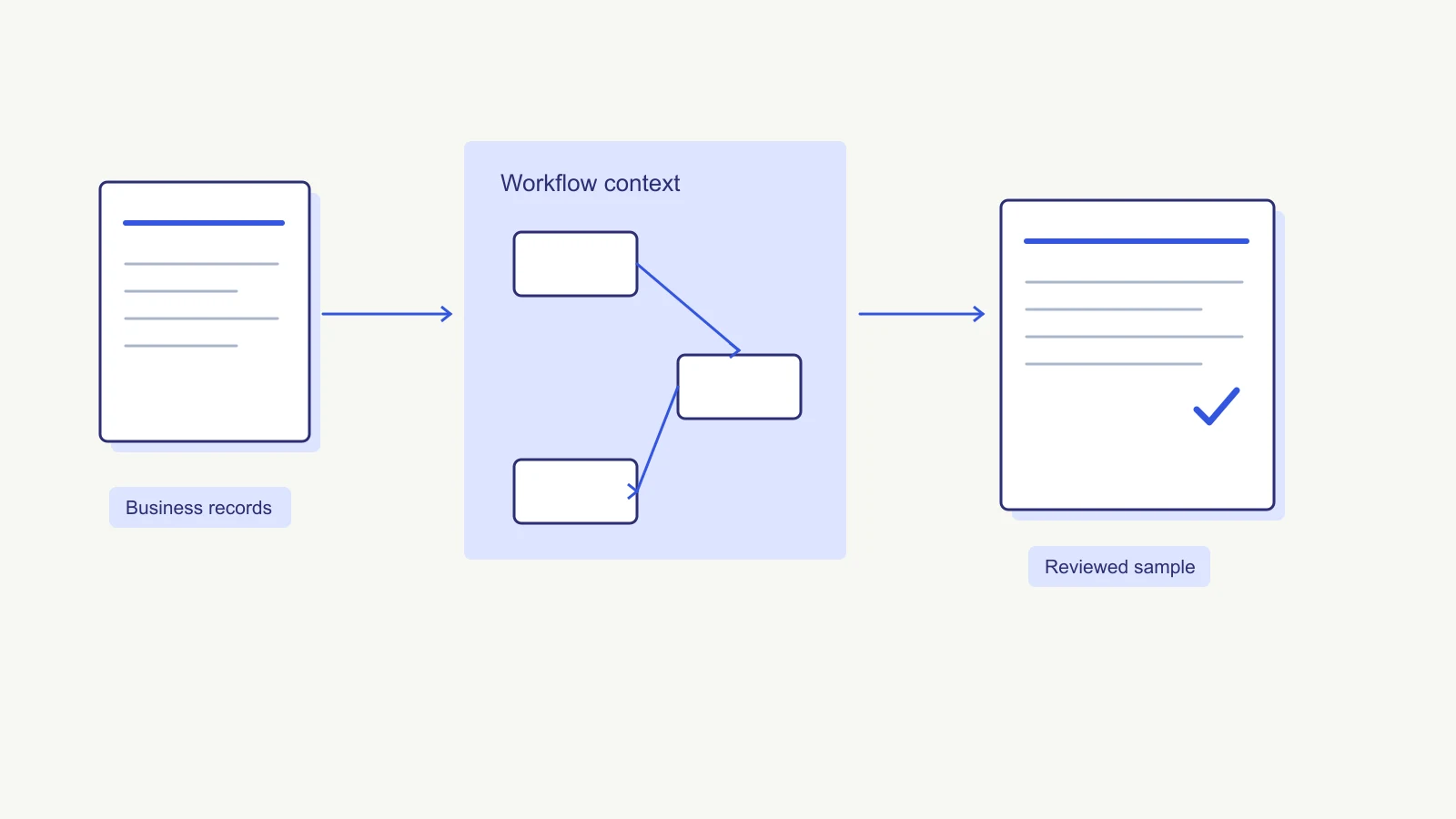
Enterprise data is useful for AI training when it contains relevant work, enough context to interpret it and a clear basis for its intended use. A large export alone does not establish any of those things. Start by asking what a model should learn or be tested on, then assess whether the records actually support that task.
This guide is for AI teams preparing a sourcing brief and organisations considering whether their records might be suitable. The checklist below is a suggested assessment framework, not a buyer’s acceptance standard.
Start with the task, not the file count
“Business documents” is a category, not a specification. A model that summarises a project may need a sequence of updates. A model that answers questions about a policy may need the policy, its effective date and the exceptions. A model that proposes a next action may need the events leading up to a decision.
Write down one example of the task before discussing volume. Identify what the model receives, what it should produce and how a reviewer would recognise a useful result. This keeps a sourcing discussion focused on relevance rather than the size of an archive.
Preserve useful relationships between records
A final report can be useful by itself, but some tasks depend on how the work developed. A project question, the response and the resulting revision may together provide context that none of those files contains alone.
For a proposed sample, consider the following questions:
| Assessment area | Question to resolve |
|---|---|
| Task fit | Which training or evaluation task can these records support? |
| Sequence | Can you tell which event or document came first? |
| Relationships | Can related records be connected using consistent identifiers? |
| Coverage | Are important stages missing from the workflow? |
| Interpretation | Are specialised terms and fields explained? |
| Permissions | Who needs to review the proposed use and contribution? |
Do not preserve identifying details simply to maintain a link. The preparation plan should establish how useful relationships can be retained while handling information that needs to be excluded or transformed.
Document what the sample represents
A sample selected only from the cleanest records may hide the preparation work needed for the wider archive. Ask how it was selected, which dates it covers and what was left out. Note duplicates, missing attachments, unreadable files and incomplete histories.
The research paper Datasheets for Datasets proposes documenting a dataset’s purpose, composition, collection and intended uses. That is a useful starting point for communication between a source and a receiving team. It does not replace project-specific checks or establish permission to use the material.
For an initial assessment, a short inventory can be more useful than sending records immediately. Include the record types, approximate coverage, available metadata, known gaps and the person responsible for discussing the contribution.
Separate suitability from readiness to share
Material can be relevant to a model and still be unsuitable for transfer in its present form. An assessment should distinguish task relevance from permission, confidentiality and preparation questions. Avoid a single “approved” label that conceals unresolved work.
Use three separate outcomes: suitable for further discussion, preparation required, and excluded. Record the reason for each outcome. This gives both sides a clearer view of what a limited first project could contain.
A useful first sourcing brief
Before approaching sources, prepare a one-page brief covering:
- The model task and a representative example.
- Languages, record types and subject matter.
- The context and metadata needed to interpret each item.
- Required exclusions and proposed review responsibilities.
- The pilot deliverable and acceptance criteria.
- Who will receive the material and the intended use.
Our AI data sourcing service starts with these requirements. If you are considering contributing records, read the data licensing preparation checklist before sending material.