

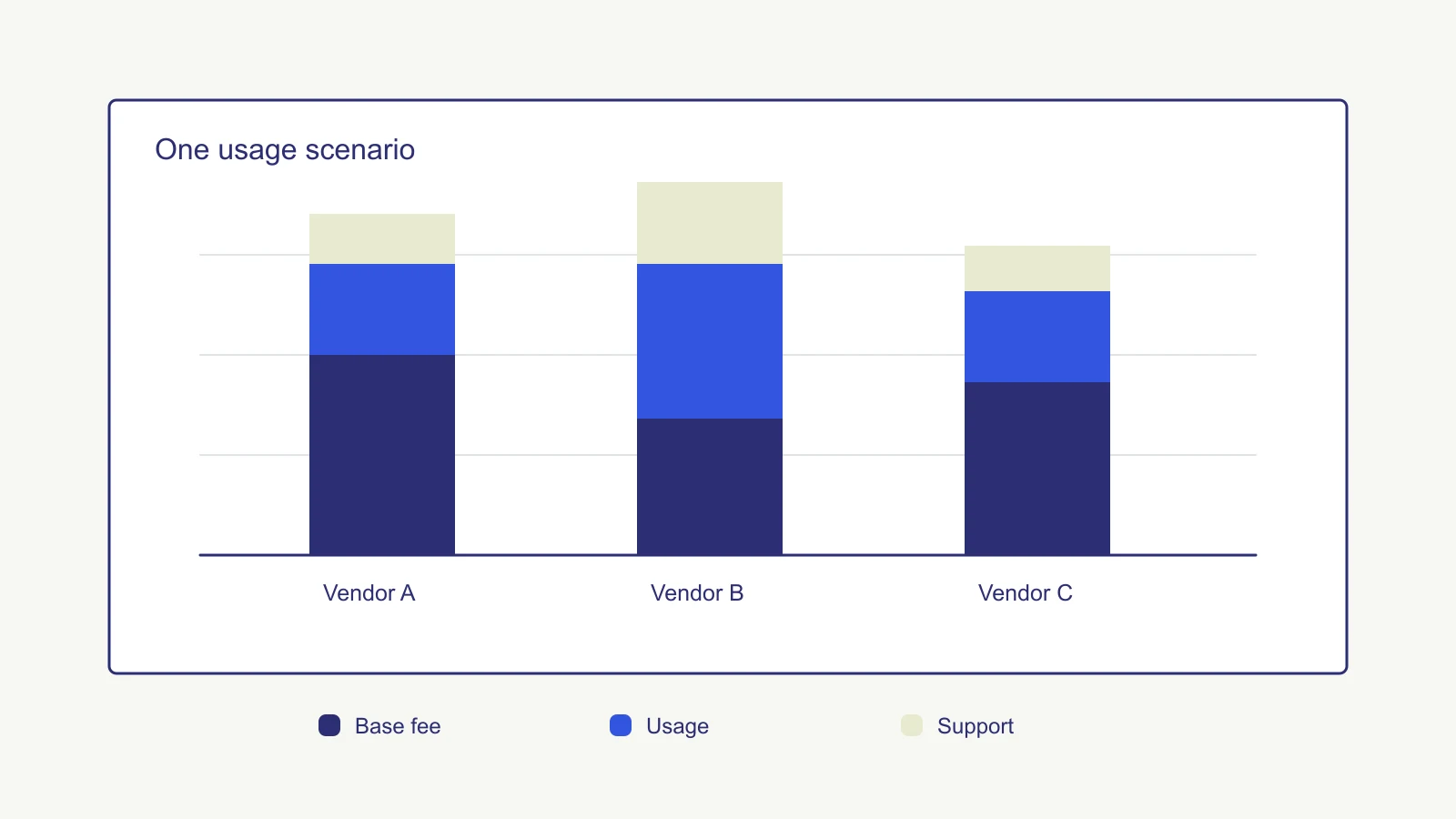
A vendor pricing comparison is useful only when the prices describe a comparable requirement. The cheapest advertised plan may exclude the users, usage, support or features your team needs. Build the comparison around a shared scenario, then record the differences that remain.
This guide provides a practical template for procurement, pricing research or competitor benchmarking. The worked example uses invented vendors and numbers to explain the calculation; it is not market pricing evidence.
Define one scenario for every vendor
Write down the number of users, expected usage, required features, support needs, contract period and currency. Separate essential features from preferences. If you compare different editions, explain why each edition is the lowest one that meets the requirement.
A scenario should be specific enough that another person can reproduce the comparison. “Small business plan” is vague. “Ten users, twelve months, the listed reporting feature and standard support” gives the reader assumptions to inspect.
For usage-based products, include a normal-use case and a higher-use case. A price advantage at one volume may disappear at another.
Build the cost table
Use a table that separates evidence from calculation. Keep the source, date and qualification notes next to the commercial fields rather than in an unrelated document.
| Field | What to record |
|---|---|
| Plan or edition | The exact product being compared. |
| Charging basis | Per user, per unit, flat fee or a combination. |
| Recurring cost | Charges over the same comparison period. |
| One-off cost | Onboarding, setup or mandatory migration. |
| Included usage | Allowances and relevant limitations. |
| Extra usage | Overage rates or the next required tier. |
| Commercial terms | Minimum commitment and renewal assumptions. |
| Evidence | Source, date and whether the figure is a quote or estimate. |
Use “not confirmed” for unknown costs. Entering zero can make an incomplete quote appear more attractive than a complete one.
Work through a simple example
Assume a hypothetical ten-user, one-year requirement. Vendor A charges $30 per user per month plus $500 onboarding. Vendor B charges a flat $300 per month with onboarding included. Assume, solely for this example, that both meet the same feature and usage requirements and there are no other charges.
- Vendor A: 10 × $30 × 12 + $500 = $4,100 in year one.
- Vendor B: $300 × 12 = $3,600 in year one.
- Year-one difference: $500.
If A’s onboarding charge does not recur and both prices stay unchanged, both would cost $3,600 in year two under these assumptions. This is why a one-year comparison should not silently become a claim about the entire relationship.
Taxes, currency conversion and optional services are excluded from this illustration. In a real comparison, state how each is treated and use consistent assumptions.
Compare suitability alongside price
Keep a separate assessment of required features, implementation effort, service limitations and support. Do not turn unverified impressions into precise scores. If you use weights, explain who chose them and which decision they represent.
A cost difference is a finding. A recommendation also requires a view on fit and uncertainty. Make that distinction clear so a reader can disagree with the judgement without losing the underlying evidence.
Keep the report usable after delivery
Record when information was checked and which items need confirmation before a purchase or pricing decision. Quotes can be conditional, and published packages can change. A report should help the reader identify what to verify next.
SOAR’s market research service can cover vendor comparisons and pricing benchmarks. Bring the decision you are making, the vendors or market of interest and the questions you cannot yet answer. We can then scope a report around those requirements.